특집논문


Abstract
References
Information
Uisang (625-702), the founder of the Korean Hwaeom tradition, was a contemporary of Fazang (643-712), the de facto founder of the Chinese Huayan tradition. Although Uisang is generally regarded as having advanced a more practice-oriented form of thought than Fazang, thinkers in both traditions developed doctrinal classification systems intended to demonstrate both the superiority and the comprehensiveness of Huayan teaching. These systems therefore comprised two dimensions: distinct teaching, which emphasizes superiority, and common teaching, which emphasizes inclusiveness. In this framework, common teaching indicates that the teaching of the three vehicles functions as an expedient means within, or is encompassed by, the Huayan teaching of the one vehicle.
However, in the thought of Zhiyan (602-668) and Fazang, the concept of common teaching includes not only comprehensiveness but also a directional aspect, namely a movement “from the one vehicle to the three vehicles.” This feature renders the scope of common teaching somewhat ambiguous. In response, Hwaeom thinkers of Uisang’s lineage, in theBeopgyedogi chongsurok , explained the common teaching of the one vehicle either as the mutual interpenetration of the one vehicle and the three vehicles or as a mediating device that leads practitioners toward the distinct teaching of the one vehicle. Although this interpretation did not entirely resolve the theoretical ambiguities left by earlier Huayan thinkers, it carried rich implications for religious practice. By contrast, Chinese Huayan thinkers of the Song period tended to emphasize only the directional aspect of common teaching and to restrict its scope to the perfect teaching, the highest category in the fivefold doctrinal classification. Although this tendency may be understood as an effort to secure greater theoretical clarity, it may also be seen as the result of a concern with sectarian orthodoxy.
Nevertheless, both traditions regarded the distinct teaching of the one vehicle as the final goal. A balanced understanding of East Asian Huayan scholasticism therefore requires attention to both its theoretical and its practical dimensions.
However, in the thought of Zhiyan (602-668) and Fazang, the concept of common teaching includes not only comprehensiveness but also a directional aspect, namely a movement “from the one vehicle to the three vehicles.” This feature renders the scope of common teaching somewhat ambiguous. In response, Hwaeom thinkers of Uisang’s lineage, in the
Nevertheless, both traditions regarded the distinct teaching of the one vehicle as the final goal. A balanced understanding of East Asian Huayan scholasticism therefore requires attention to both its theoretical and its practical dimensions.
해동 화엄종의 개조인 의상(義相 또는 義湘, 625-702)은 그와 동시대인이자 중국 화엄종의 실질적 개조인 법장(法藏, 643-712)에 비해 보다 실천적인 사상을 전개한 것으로 알려져 있다. 그러나 두 지역의 화엄가들은 자기 종파의 가르침이 다른 가르침들보다 뛰어나면서도 동시에 그것들을 포괄하고 있음을 보이려는 교판(敎判)을 전개하였다는 공통점이 있다. 따라서 그들이 제시한 교판 체계는 ‘수승함’을 강조하는 별교(別敎)와 ‘포괄성’에 주목하는 동교(同敎)라는 두 측면을 포함하고 있는데, 후자는 화엄종의 가르침과 동일시되는 일승에 삼승이 방편으로서 기능한다거나 포함됨을 의미한다.
그런데 지엄(智儼, 602-668)이나 법장의 동교 개념에는 포괄성 외에 ‘일승으로부터 삼승으로’라는 방향성의 측면도 포함되어 있기 때문에 동교의 외연이 불명확하다는 문제점이 있다. 이와 관련하여 의상계 화엄가들은 『법계도기총수록』에서 일승동교를 일승과 삼승의 상입(相入)으로 설명하거나 수행자를 일승별교로 이끌기 위한 하나의 매개로서 이해하였다. 이는 초기 화엄가들의 이론적 모호성을 완전히 해소한 것은 아니지만, 수행론적으로는 매우 풍부한 함축을 지니고 있다고 할 수 있다. 이에 반해 중국 송대의 화엄가들은 일승동교의 동교 개념의 방향성만을 강조하면서 그 외연을, 5교 교판의 최상위에 위치하는 원교에 한정하려는 경향이 강하였다. 이는 이론적 명료성을 확보하려는 시도이긴 하지만, 종파적 정통성을 추구한 결과로 볼 수도 있을 것이다.
그러나 양자 모두 일승별교를 최종적인 귀결로 보았다는 공통점이 있으므로 동아시아 화엄교학의 이론적 측면과 실천적 측면에 대한 균형 있는 고찰이 필요하다.
그런데 지엄(智儼, 602-668)이나 법장의 동교 개념에는 포괄성 외에 ‘일승으로부터 삼승으로’라는 방향성의 측면도 포함되어 있기 때문에 동교의 외연이 불명확하다는 문제점이 있다. 이와 관련하여 의상계 화엄가들은 『법계도기총수록』에서 일승동교를 일승과 삼승의 상입(相入)으로 설명하거나 수행자를 일승별교로 이끌기 위한 하나의 매개로서 이해하였다. 이는 초기 화엄가들의 이론적 모호성을 완전히 해소한 것은 아니지만, 수행론적으로는 매우 풍부한 함축을 지니고 있다고 할 수 있다. 이에 반해 중국 송대의 화엄가들은 일승동교의 동교 개념의 방향성만을 강조하면서 그 외연을, 5교 교판의 최상위에 위치하는 원교에 한정하려는 경향이 강하였다. 이는 이론적 명료성을 확보하려는 시도이긴 하지만, 종파적 정통성을 추구한 결과로 볼 수도 있을 것이다.
그러나 양자 모두 일승별교를 최종적인 귀결로 보았다는 공통점이 있으므로 동아시아 화엄교학의 이론적 측면과 실천적 측면에 대한 균형 있는 고찰이 필요하다.
- T
Taishō shinshū daizōkyō 大正新修大藏經, ed. by TAKAKUSU Junjirō 高楠順次郞 and WATANABE Kaikyoku 渡邊海旭, 100 vols. Tokyo: Daizōkyōkai, 1924-1935. - X
Manji shinsan Dai Nihon zokuzōkyō 卍新纂大日本續藏經 (Revised reprint of the Dai Nihon zokuzōkyō). Edited by KAWAMURA Kōshō 河村照孝, et al. 88 vols. Tokyo: Kokusho Kankōkai, 1975-1989. - 『大方廣佛華嚴經搜玄分齊通智方軌』 (T1732)
- 『法界圖記叢髓錄』 (H107)
- 『註同敎問答』 (X1017)
- 『華嚴經內章門等雜孔目章』 (T1870)
- 『華嚴經問答』 (T1873)
- 『華嚴經旨歸』 (T1871)
- 『華嚴五十要問答』 (T1869)
- 『華嚴一乘敎義分齊章焚薪』 (X996)
- 『華嚴一乘敎義分齊章』 (T1866)
- 『華嚴一乘法界圖』 (H28)
- CHO, Yoonho 曺潤鎬 and SATO, Atsushi 佐藤厚. 2000. 「韓国華厳学の研究」 (“Studies on Korean Hua-yen Buddhism in Japan”), 『韓国仏教学セミナ-』 (
Journal of Korean Buddhist Seminar ), no. 8, 12-65. - CHOE, Yeonshik 최연식. 2011. 「신라 및 고려시대 화엄학 문헌의 성격과 내용」 (“The Contents and Character of the Huayan Literature in Shilla and Koryo Dynasties”), 『불교학보』 (
Journal of Buddhist Culture Research Institute ), vol. 60, 235-262. - _______. 2016. 「한국불교에서의 성기(性起)와 연기(緣起)-의상 화엄사상의 성기적 이해에 대한 재검토-」 (“Understanding on Huayan Theory of
Seonggi (Xingqi ) andYeon’gi (Yuanqi ) in Korean Buddhism: Focusing on the Differences between Uisang’s and Jinul’s Thought”), 『불교학보』 (Journal of Buddhist Culture Research Institute ), vol. 74, 245-269.10.18587/bh.2016.03.74.245 - HAEJU 해주, tr. 2010. 『정선 화엄Ⅰ』 (
Hwaŏm I: The Mainstream Tradition ), Seoul: Jogye Order of Korean Buddhism. - HAN, Jongman 韓鍾万. 1982. 「朝鮮朝初期雪岑の法界図註釈」 (“The Interpretation by Sul-Jam of
Bub-kye-do in the Early Rhe Dynasty”), 『印度學佛敎學硏究』 (Journal of Indian and Buddhist Studies ), vol. 30, no. 2, 172-175.10.4259/ibk.30.679 - ISHII, Kosei 이시이 코세이, KIM, Chonhak 김천학, tr.. 2020. 『화엄사상의 연구』 (
A Study of Huayan Thought ). Seoul: Minjoksa 민족사. - JUNG, Byungsam 정병삼. 2023. 『의상』 (Uisang). Seongnam: Academy of Korean Studies Press 한국학중앙연구원출판부.
- KAMATA, Shigeo 鎌田茂雄. 1979. 『華厳五教章』 (
Huayan wujiao zhang ), 佛典講座 28. Tokyo: Daizō shuppan 大藏出版. - KANAME, Fujimaru 藤丸要. 2019. 「日本における華厳教学の展開」 (*“Development of Huayan Scholasticism in Japan”). Research Center for Buddhist Cultures in Asia, Ryukoku University 龍谷大学アジア仏教文化研究センター.
- KIM, Chonhak 金天鶴. 2012. 「東アジアの華厳思想における無碍説」 (“Huayan Philosophy in East Asia: Focusing on the Theory of Non-obstruction”), 『インド哲学仏教学研究』 (
Studies In Indian Philosophy And Buddhism , Tokyo University), no. 12, 53-67. - _______. 2012. 「동아시아 화엄사상에서 의상과 법장의 위상」 (“The Status of Uisang and Fazang in East Asian Huayan Studies”), 『불교학보』 (
Journal of Buddhist Culture Research Institute ), vol. 61, 65-87. - _______. 2005. 「義相系の華厳学における一乗義の特質」 (“One Vehicle in the Huayan school of Uisang and Its Main Character”), 『東洋文化研究』 (
Journal of Asian Cultures ), no. 7, 229-251. - KIM, Sanghyun 김상현. 2013. 『교감번역 화엄경문답』 (*Critical Edition and Translation of the
Hwaeomgyeong mundap ). Nonsan: Geumgang Center for Buddhist Studies 금강대학교 불교문화연구소. - KIM, Yongtae 김용태. 2012. 「동아시아의 징관(澄觀)화엄 계승과 그 역사적 전개: 송대와 조선후기 화엄교학을 중심으로」 (“The Legacy of Jing’gwan’s Teaching of Hwa'eom Buddhism throughout East Asia, and Its Historical Meaning: Examination of the Hwa’eom-based Academic Buddhism of the Chinese Sung dynasty, and Also of the Latter Half Period of the Joseon Dynasty”), 『불교학보』 (
Journal of Buddhist Culture Research Institute ), vol. 61, 267-296. - KOH, Ikjin 고익진. 1989. 『한국고대불교사상사』 (*
History of Buddhist Thought in Ancient Korea ). Seoul: Dongguk University Press 동국대학교 출판부. - KOH, Seunghak 고승학. 2024. 「‘즉(卽)’에 대한 당·송대 화엄교학의 이해-형이상학적 해석과 교판적 해석을 중심으로」 (“Understanding of ‘
Ji ’ (卽) by Tang-Song Huayan Scholasticism: Focused on Its Metaphysics and Doctrinal Classification Schemes”). 『밀교학불교학연구』 (Journal of Esoteric and Buddhist Studies ), vol. 6, 127-163. - LEE, Miseon 이미선(정우). 2018. 「『대기(大記)』의 오중해인(五重海印)에 대한 소고(小考)」 (“A Study on the Thought of the Ocean Seal Samādhi in Five Ways (五重海印) in
Daegi (大記)”), 『동아시아불교문화』 (Journal of Eastern-Asia Buddhism and Culture ), vol. 35, 181-215.10.21718/EABC.2018.35.07 - LIM, Sangmok 임상목. 2024. 「송대 천태 부흥의 시대적 배경 고찰」 (“A Review of the Historical Background of the Cheontaejong Revival of the Song Dynasty”), 『동아시아불교문화』 (
Journal of Eastern-Asia Buddhism and Culture ), vol. 62, 183-210.10.21718/EABC.2024.62.07 - PARK, Boram 박보람. 2022. 「의상(義相) 이이상즉설(理理相卽說) 논의의 비판적 고찰」 (“Critical Review of Discussions on the Theory of the Mutual Identity of Principle and Principle”), 『불교학보』 (
Journal of Buddhist Culture Research Institute ), vol. 100, 41-67.10.18587/bh.2022.11.100.41 - SATO, Atsushi 佐藤厚. 1995. 「均如 『一乗法界図円通記』と「大記」との関連」 (“The Relation between Kyunnyo’s
Ilsǔng pǒpkye do wong tooug ki and theTae ki ”), 『印度學佛教學研究』 (Journal of Indian and Buddhist Studies ), vol. 43, no. 2, 759-761.10.4259/ibk.43.759 - _______. 2015. 「『일승법계도(一乘法界圖)』의 텍스트 문제」 (“The Text Problem of
Il Seung Beopgye-do ”), 『한국사상사학』 (The Study of Korean History of Thought ), vol. 49, 31-52. - _______. 2018. 「儀礼文献としての『一乗法界図』」 (*“
Ilseung beopgyedo as A Liturgical Text”), 『専修人文論集』 (The Journal of the Senshu University Research Society ), no. 103, 361-380. - _______. 2022. 「韓国普光寺所蔵「所詮章」断簡―高麗時代の『華厳五教章』テキストをめぐる問題」 (“Manuscript of the ‘
Suo quan zhang (所詮章)’ Kept in the Pogwangsa Temple, Korea: The Problem of the Text of ‘Huayan wujiao zhang ’ in the Koryo Period”), 『東アジア仏教研究』 (The Journal of East Asian Buddhist Studies ), no. 20. - _______. 2023. 「『華厳五教章』の成立をめぐる文献学的問題」 (“Philological Problems of the Establishment of the Huayan wujiao zhang”), 『東アジア仏教学術論集』 (
Studies in East Asian Buddhism ), no. 11, 117-137. - SEOK, Gilam 석길암. 2013. 「韓國 華嚴思想의 성립과 전개에 보이는 몇 가지 傾向性-智儼과 元曉, 智儼과 義湘의 대비를 통해서-」 (“A Few Tendency in Korean Huayen Ideology”), 『동아시아불교문화』 (
Journal of Eastern-Asia Buddhism and Culture ), vol. 13, 3-29. - YOSHIDA, Takashi 吉田剛. 1996a. 「趙宋華厳学の展開-法華経解釈の展開を中心として-」 (“The Development of the Huayen Philosophy in the Song Dynasty on the Development of the Interpretations on the Lotus sutra”), 『駒沢大学仏教学部論集』 (
Journal of Buddhist Studies ), no. 27, 215-226. - _______. 1996b. 「『融会一乗義章明宗記』の成立背景」 (“The Background of the Formation of the
Ronghui yicheng yizhang mingzong-ji ”), 『印度学仏教学研究』 (Journal of Indian and Buddhist Studies ), vol. 45, no. 1, 84-86.10.4259/ibk.45.84 - YOSHIZU, Yoshihide 吉津宜英. 1991. 『華厳一乗思想の研究』 (
A Study on the Hua-yen One Vehicle Doctrine ). Tokyo: Daizō shuppan 大藏出版.
◆ 약호 및 일차 문헌 Abbreviations and Primary Sources
◆ 이차 문헌 Secondary Literature
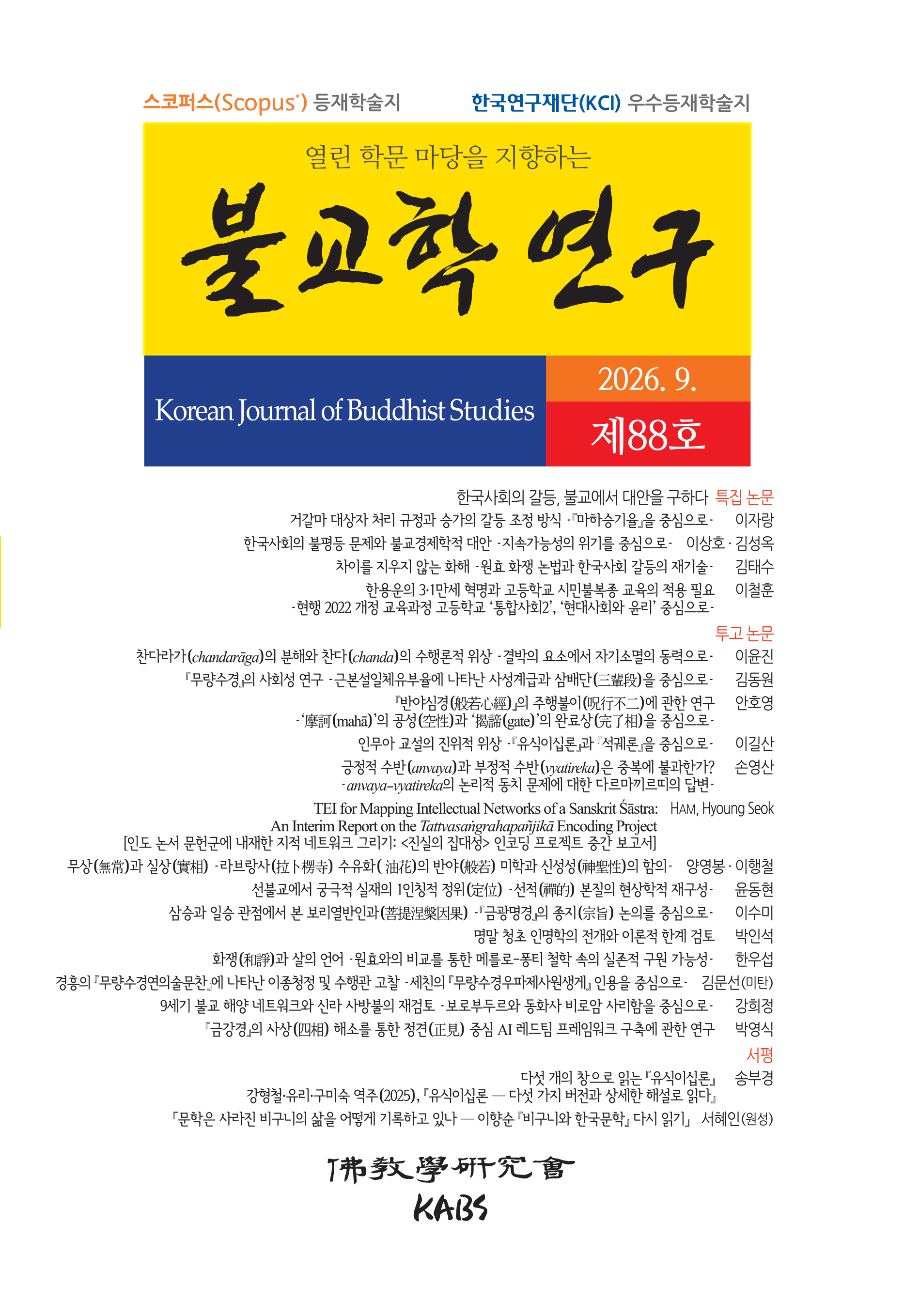
- Publisher :Korean Association of Buddhist Studies
- Publisher(Ko) :불교학연구회
- Journal Title :Korean Journal of Buddhist Studies
- Journal Title(Ko) :불교학연구
- Volume : 86
- Pages :1∼30
- DOI :https://doi.org/10.21482/jbs.86..202603.1
 Korean Journal of Buddhist Studies