투고논문


Abstract
References
Information
This paper examines the transmission history and theoretical limitations of hetuvidyā (Buddhist logic) in the late Ming and Early Qing Period. Although hetuvidyā flourished for approximately one century during the Tang dynasty, its lineage gradually died out thereafter. In the late Ming and early Qing period, four scholars — Zhenjie (眞界), Wang Kentang (王肯堂), Mingyu (明昱), and Zhixu (智旭) — compiled commentaries on the Nyāyapraveśa , providing an opportunity for its revival. Concerning transmission history, the postscript of Zhenjie and the preface of Wang Kentang confirm that hetuvidyā transmission had effectively been severed in late Ming and early Qing Buddhist circles. Both scholars were compelled to rely on fragmentary citations preserved in Chengguan’s (澄觀) Huayan jing suishu yanyi chao and Yanshou’s (延壽) Zongjing lu , as Tang-dynasty hetuvidyā commentaries were no longer available. Concerning theoretical limitations, the four scholars share two common errors. The first is confusion between zongyi (宗依) and zongt’i (宗體). In the established commentarial tradition, zongyi refers to the subject and predicate terms individually, while zongt’i denotes the complete propositional thesis; all four scholars erroneously identified the predicate term with zongt’i. The second error concerns pakṣadharmatva (遍是宗法性), which requires the hetu to pervade the subject term of the thesis. All four scholars misidentified the relevant referent of “zong” as the predicate rather than the subject. These two errors are mutually entailed: misidentifying the predicate as zongt’i necessarily displaced the reference point of pakṣadharmatva toward the predicate term. While the late Ming and early Qing revival of hetuvidyā carries genuine historical significance, it must be judged as falling short of full theoretical reconstruction.
본고는 명말 청초 인명학의 전승 경위와 이론적 한계를 고찰한 것이다. 동아시아에서 인명학은 당대(唐代) 약 1세기간 크게 선양되다가 이후 그 명맥이 점차 끊어졌지만, 명말 청초에 이르러 진계(眞界)·왕긍당(王肯堂)·명욱(明昱)·지욱(智旭)의 4인에 의해 『인명입정리론』에 대한 주석서가 편찬되면서 부흥의 계기가 마련되었다. 전승 경위와 관련하여, 진계의 「발문」과 왕긍당의 「자서」를 통해 당시 불교계에서 인명학의 전승이 사실상 단절된 상태였음을 확인할 수 있다. 진계는 설랑홍은(雪浪洪恩)과 옥암좌주(玉菴座主)로부터 가르침을 받았고, 왕긍당은 진계·진징(鎭澄)·온박(蘊璞)의 주석을 차례로 접하면서 이해를 심화하였다. 그러나 두 사람 모두 당대의 인명학 주석서를 직접 활용하지 못하고, 징관의 『화엄경수소연의초』와 연수의 『종경록』 등에 남아 있는 단편적 인용문에 의존할 수밖에 없었다.
이론적 한계와 관련하여, 4인 공통의 오류는 크게 두 가지로 정리된다. 첫째는 종의(宗依)와 종체(宗體) 개념의 혼동이다. 인명학의 주석 전통에서 종의는 전진(前陳)과 후진(後陳) 각각을 가리키고, 종체는 양자의 결합인 주장 명제 전체를 가리키지만, 4인 모두 후진을 종체로 간주하는 오류를 보였다. 둘째는 변시종법성에 대한 잘못된 이해이다. 이는 인(因)이 종의 유법(有法), 곧 전진에 두루 적용되는 법임을 가리키는데, 4인 모두 이 ‘종’을 후진으로 오인하였다. 오해의 양상은 4인 각각에서 다소 다르게 나타난다. 진계는 종법성을 인이 종의 후진에 두루 적용되는 총상[總]으로 규정하고 제2·3상을 별상[別]으로 설정하였고, 왕긍당은 동품정유성·이품변무성을 동유·이유의 실례에 근거하여 설명함으로써 삼상과 유(喩) 사이의 논리적 층위 차이를 불분명하게 하였다. 명욱은 구구인 게송의 ‘구(俱)’를 변시종법성과 동치로 오독하여 종·인·유에 대한 유례없는 2분 구조를 낳았으며, 지욱은 종법성의 범위를 전진·후진 양자로 과도하게 확장하였다. 이상의 두 오류는 서로 연동된 것으로, 명말 청초 인명학의 부흥은 역사적 의의를 지니지만 이론적 재건이라는 측면에서는 완성에 이르지 못한 것으로 볼 수 있다.
이론적 한계와 관련하여, 4인 공통의 오류는 크게 두 가지로 정리된다. 첫째는 종의(宗依)와 종체(宗體) 개념의 혼동이다. 인명학의 주석 전통에서 종의는 전진(前陳)과 후진(後陳) 각각을 가리키고, 종체는 양자의 결합인 주장 명제 전체를 가리키지만, 4인 모두 후진을 종체로 간주하는 오류를 보였다. 둘째는 변시종법성에 대한 잘못된 이해이다. 이는 인(因)이 종의 유법(有法), 곧 전진에 두루 적용되는 법임을 가리키는데, 4인 모두 이 ‘종’을 후진으로 오인하였다. 오해의 양상은 4인 각각에서 다소 다르게 나타난다. 진계는 종법성을 인이 종의 후진에 두루 적용되는 총상[總]으로 규정하고 제2·3상을 별상[別]으로 설정하였고, 왕긍당은 동품정유성·이품변무성을 동유·이유의 실례에 근거하여 설명함으로써 삼상과 유(喩) 사이의 논리적 층위 차이를 불분명하게 하였다. 명욱은 구구인 게송의 ‘구(俱)’를 변시종법성과 동치로 오독하여 종·인·유에 대한 유례없는 2분 구조를 낳았으며, 지욱은 종법성의 범위를 전진·후진 양자로 과도하게 확장하였다. 이상의 두 오류는 서로 연동된 것으로, 명말 청초 인명학의 부흥은 역사적 의의를 지니지만 이론적 재건이라는 측면에서는 완성에 이르지 못한 것으로 볼 수 있다.
- T Taishō shinshū daizōkyō 大正新修大藏經, ed. by TAKAKUSU Junjirō 高楠順次郞 and WATANABE Kaikyoku 渡邊海旭, 100 vols. Tokyo: Daizōkyōkai, 1924-1935.
- X Shinsan Dainihon zokuzōkyō 新纂大日本續藏經, 90 vols. Tokyo: Kokusho Kankōkai 國書刊行會, 1975–1989.
- J Jiaxing dazangjing 嘉興大藏經 (嘉興藏). Ming–Qing period original. [CBETA electronic edition based on the Jiaxing Canon.]
- 『因明正理門論』 T1628.
- 『因明入正理論』 T1630.
- 『因明入正理論疏』 T1840.
- 『華嚴經隨疏演義鈔』 T1736.
- 『宗鏡錄』 T2016.
- 『密藏開禪師遺稿』 J_B118.
- 『因明入正理論解』 X856.
- 『因明入正理論集解』 X857.
- 『因明入正理論直疏』 X858.
- 『因明入正理論直解』 X859.
- 『大佛頂首楞嚴經疏解蒙鈔目錄』 X287.
- 『大明高僧傳』 T2062.
- 『補續高僧傳』 X1524.
- CHEN, Shuai 陳帥. 2021. 「明清因明史上被忽視的一環——明釋眞貴《因明入正理論集解》評析」 (“An Overlooked Link in the History of Buddhist Logic in the Ming and Qing: Zhengui's Ming Commentary on the Yinming ru zhengli lun”), 佛光學報 (
Foguang xuebao ), n.s. vol. 7, no. 2, 47-74. - KOH, Seunghak 고승학. 2024. 「송대 이후 중국불교사에 보이는 인명(因明)의 적용과 그 의의」 (“Application of Hetuvidyā and Its Significance in the History of Chinese Buddhism after the Song Period”), 『한국불교학』 (
Korea Journal of Buddhist Studies ), vol. 109, 183-219. 10.22255/JKABS.109.07. - HU, Jianwen 胡建文. 2022. “The Social Network of Metropolitan Graduates in the Sessions of 1589 and 1592, the Jesuit Mission and Sino-Western Cultural Encounter in the Late-Ming Dynasty,” PhD dissertation, Università degli Studi di Padova.
- LEE, Ji-su 이지수. 1987. 「佛敎論理學 入門」 (“Introduction to Buddhist Logic”), 哲學論叢 (
Philosophical Theses ), vol. 3, 29-52. - SAIGUSA, Mitsuyoshi 三枝充悳 and SHIM, Bong-seop 심봉섭, tr. 1996. 『인식론·논리학』 (認識論·論理學), Seoul: Bulgyosidaesa 불교시대사.
- SHEN, Jianying 沈劍英, ed. 2001. 『中國佛敎邏輯史』 (
History of Chinese Buddhist Logic ), Shanghai: East China Normal University Press 華東師範大學出版社. - SHENGYAN 聖嚴 法師. 2006. 『明末佛敎硏究』 (
Research on Buddhism in the Late Ming Dynasty ), Beijing: Religious Culture Press 宗敎文化出版社. - ZHENG, Weihong 鄭偉宏. 1999. 『因明正理門論直解』 (
Direct Explanation of the Nyāyamukha ), Shanghai: Fudan University Press 復旦大學出版社.
◆ 약호 및 일차 문헌 Abbreviations and Primary Sources
◆ 이차 문헌 Secondary Literature
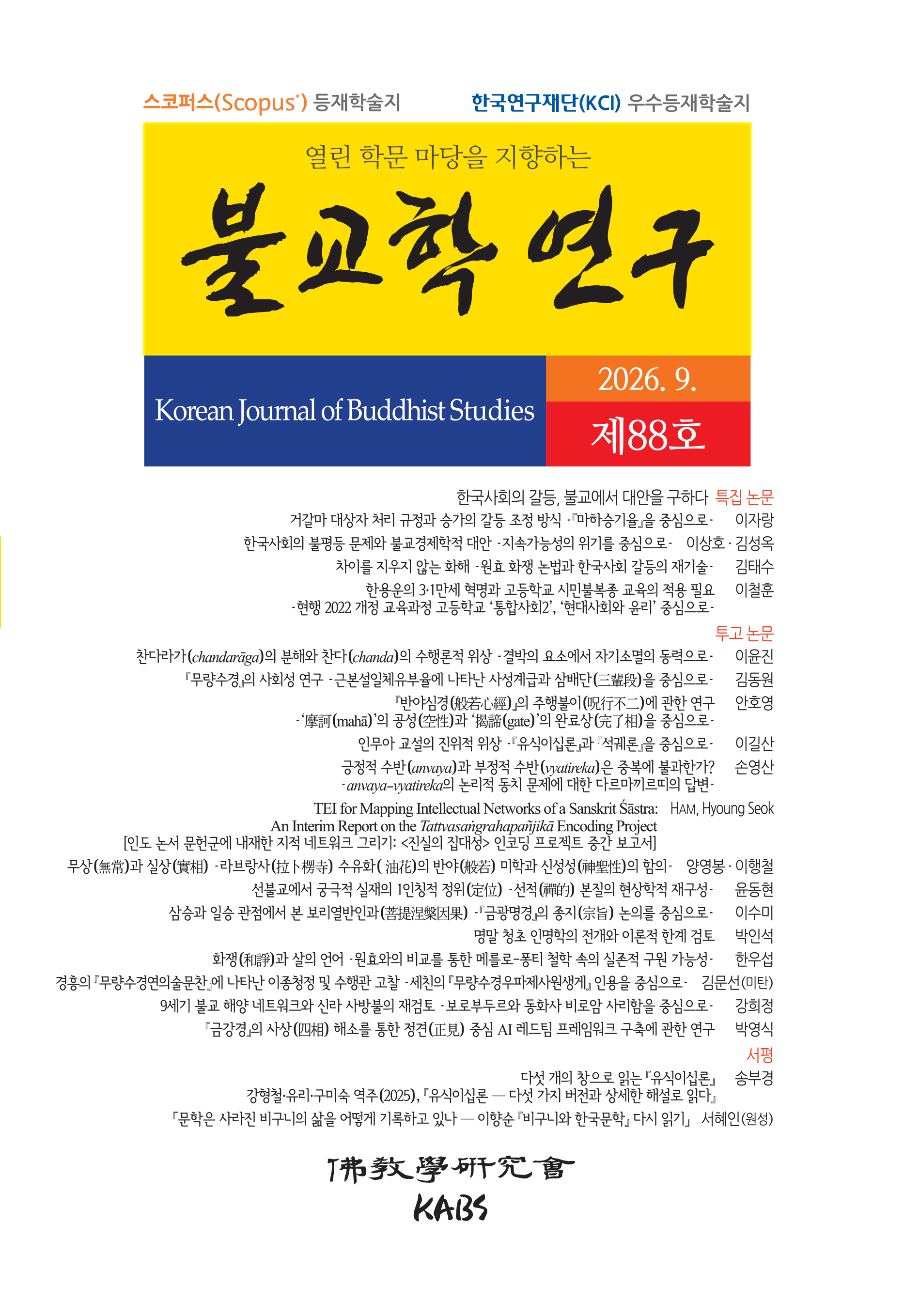
- Publisher :Korean Association of Buddhist Studies
- Publisher(Ko) :불교학연구회
- Journal Title :Korean Journal of Buddhist Studies
- Journal Title(Ko) :불교학연구
- Volume : 88
- Pages :389∼417
- DOI :https://doi.org/10.21482/jbs.88..202609.389
 Korean Journal of Buddhist Studies