특집논문


Abstract
References
Information
This study examines ukkhepaniyakamma (the act of suspension) in the Mahāsāṃghika Vinaya, focusing on its subjects and procedure, the treatment of suspended monks, mediation by a sthalastha (他邏咃 ), and coexistence in separate communions (異住 ), that is, coexistence while belonging to different monastic affiliations. It compares these regulations with those of Vinaya texts belonging to the Sthavira lineage, including the Pāli Vinaya, to clarify their similarities and differences. Through this comparison, the study identifies the distinctive approach of the Mahāsāṃghika Vinaya to conflict management and the principles of Saṃgha governance shared across Vinaya traditions.
Theukkhepaniyakamma is imposed upon a monk who refuses to acknowledge or make amends for an offence, or who persists in holding wrong, heterodox, or extreme views. Because it is carried out while the monk continues to reject the Saṃgha’s judgment, it may intensify conflict and, in some cases, lead to schism. The Kosambakakkhandhaka of the Pāli Vinaya describes how a divided Saṃgha eventually restored unity through a reconciliation Uposatha (sāmaggi-uposatha ). The Mahāsāṃghika Vinaya, by contrast, excludes suspended monks more strictly from communal life while providing for mediation by an impartial sthalastha . If the monk recovers right view, he may be reinstated through the revocation of the suspension. If he continues to reject the Saṃgha’s judgment, separate residence allows the opposing groups to coexist in different communities, preventing disintegration while preserving the possibility of future reconciliation.
Although the two traditions differ in the severity of restrictions imposed upon suspended monks, both seek to restore order and harmony through a gradual process of conflict management. Discipline is thus understood not merely as punishment or permanent exclusion, but as a means of encouraging transformation and reintegration. When immediate agreement is impossible, impartial mediation and provisional separation may mitigate conflict and preserve the community. These principles offer meaningful insights for reconsidering disciplinary and dispute-resolution systems in contemporary Buddhist communities.
Although the two traditions differ in the severity of restrictions imposed upon suspended monks, both seek to restore order and harmony through a gradual process of conflict management. Discipline is thus understood not merely as punishment or permanent exclusion, but as a means of encouraging transformation and reintegration. When immediate agreement is impossible, impartial mediation and provisional separation may mitigate conflict and preserve the community. These principles offer meaningful insights for reconsidering disciplinary and dispute-resolution systems in contemporary Buddhist communities.
The
Although the two traditions differ in the severity of restrictions imposed upon suspended monks, both seek to restore order and harmony through a gradual process of conflict management. Discipline is thus understood not merely as punishment or permanent exclusion, but as a means of encouraging transformation and reintegration. When immediate agreement is impossible, impartial mediation and provisional separation may mitigate conflict and preserve the community. These principles offer meaningful insights for reconsidering disciplinary and dispute-resolution systems in contemporary Buddhist communities.
Although the two traditions differ in the severity of restrictions imposed upon suspended monks, both seek to restore order and harmony through a gradual process of conflict management. Discipline is thus understood not merely as punishment or permanent exclusion, but as a means of encouraging transformation and reintegration. When immediate agreement is impossible, impartial mediation and provisional separation may mitigate conflict and preserve the community. These principles offer meaningful insights for reconsidering disciplinary and dispute-resolution systems in contemporary Buddhist communities.
본 연구는 대중부의 『마하승기율』을 중심으로 거갈마(擧羯磨, ukkhepaniyakamma)의 적용 대상과 시행 절차, 거갈마를 받은 비구에 대한 대처 방식, 타라타(他邏咃)를 통한 중재, 그리고 이주(異住)를 통한 병존 방식을 검토하고, 이를 빨리율을 비롯한 상좌부 계통 율장과 비교하여 그 동이점을 고찰하였다. 이를 통해 『마하승기율』의 갈등 조정 방식과 여러 율장 전통이 공유하는 승가 운영 원리를 밝히고자 하였다.
거갈마는 범계를 저지른 뒤에도 자신의 죄를 인정하지 않거나, 참회하지 않는 자, 또는 악견(惡見)·악사견(惡邪見)·변견(邊見)을 고집하는 자에게 시행되는 징계 절차이다. 당사자가 승가의 판단을 받아들이지 않는 상태에서 시행된다는 점에서, 거갈마는 승가 내부의 갈등을 심화시키거나 경우에 따라 파승으로 이어질 가능성도 있다. 빨리율 「꼬삼비건도(Kosambakakkhandhaka)」는 거갈마를 계기로 승가가 분열되고, 이후 화합포살을 통해 다시 화합승가를 회복하는 과정을 보여준다. 한편, 『마하승기율』은 거갈마를 받은 비구를 공동체 생활에서 보다 엄격하게 배제하는 동시에, 어느 한쪽에도 치우치지 않는 타라타를 중재자로 두어 갈등을 조정한다. 당사자가 정견을 회복하면 사거갈마를 통해 승가에 복귀시키며, 끝내 승가의 판단을 받아들이지 않는 경우에는 이주를 통해 서로 다른 공동체에서 병존하게 함으로써 장차 화합과 재통합의 가능성을 열어 둔다. 양 전통은 구체적인 대응 방식과 제재의 정도에서는 차이를 보이지만, 갈등을 단계적으로 조정하여 궁극적으로 승가의 질서와 화합을 회복하고자 한다는 공통된 원리를 보여준다. 특히 징계를 단순한 처벌이나 영구적 배제가 아니라 당사자의 변화와 복귀를 위한 절차로 운용하고, 합의가 어려운 경우에는 중재나 잠정적 분리를 통해 갈등의 확산을 막고 장래의 재통합 가능성을 남겨 둔다는 점이 주목된다. 이러한 갈등 조정 방식은 현대 불교 공동체의 징계와 분쟁 해결 제도를 성찰하는 데에도 일정한 시사점을 제공한다.
거갈마는 범계를 저지른 뒤에도 자신의 죄를 인정하지 않거나, 참회하지 않는 자, 또는 악견(惡見)·악사견(惡邪見)·변견(邊見)을 고집하는 자에게 시행되는 징계 절차이다. 당사자가 승가의 판단을 받아들이지 않는 상태에서 시행된다는 점에서, 거갈마는 승가 내부의 갈등을 심화시키거나 경우에 따라 파승으로 이어질 가능성도 있다. 빨리율 「꼬삼비건도(Kosambakakkhandhaka)」는 거갈마를 계기로 승가가 분열되고, 이후 화합포살을 통해 다시 화합승가를 회복하는 과정을 보여준다. 한편, 『마하승기율』은 거갈마를 받은 비구를 공동체 생활에서 보다 엄격하게 배제하는 동시에, 어느 한쪽에도 치우치지 않는 타라타를 중재자로 두어 갈등을 조정한다. 당사자가 정견을 회복하면 사거갈마를 통해 승가에 복귀시키며, 끝내 승가의 판단을 받아들이지 않는 경우에는 이주를 통해 서로 다른 공동체에서 병존하게 함으로써 장차 화합과 재통합의 가능성을 열어 둔다. 양 전통은 구체적인 대응 방식과 제재의 정도에서는 차이를 보이지만, 갈등을 단계적으로 조정하여 궁극적으로 승가의 질서와 화합을 회복하고자 한다는 공통된 원리를 보여준다. 특히 징계를 단순한 처벌이나 영구적 배제가 아니라 당사자의 변화와 복귀를 위한 절차로 운용하고, 합의가 어려운 경우에는 중재나 잠정적 분리를 통해 갈등의 확산을 막고 장래의 재통합 가능성을 남겨 둔다는 점이 주목된다. 이러한 갈등 조정 방식은 현대 불교 공동체의 징계와 분쟁 해결 제도를 성찰하는 데에도 일정한 시사점을 제공한다.
- AN
Aṅguttara-Nikāya , ed. by R. MORRIS, vol. 2, London: Pali Text Society, 1976. - MN-a
Papañcasūdanī Majjhimanikāyaṭṭhakathā of Buddhaghosācariya , ed. by WOODS, J.H. and KOSAMBI, D. Part Ⅱ suttas 11-50, London: Pali Text Society, 1979. - NPED
A Dictionary of Pāli , by Cone, M.Part Ⅰ a-kh, Oxford: Pali Text Society, 2001.A Dictionary of Pāli , by Cone, M.Part Ⅱ g-n, Bristol: Pali Text Society, 2010. - PED Pali-English Dictionary, London: Pali Text Society.
- Sp
Samantapāsādikā , ed. by TAKAKUSU, J., NAGAI, M. and MIZUNO, K. 7 vols, London: Pali Text Society, 1924-1947. - T
Taishō shinshū daizōkyō 大正新修大藏經, ed. by TAKAKUSU, Junjirō (高楠順次郞) and WATANABE, Kaikyoku (渡邊海旭), 100 vols. Tokyo: Daizōkyōkai, 1024-1935. - Vin
Vinayapiṭakaṃ , ed. by OLDENBERG, H. 5 vols. London: Pali Text Society, 1969-1982 (reprints). - 『마하승기율』 T1425
- 『사분율』 T1428
- 『십송률』 T1435
- 『오분율』 T1421
- 『잡아함경』 T0099
- 『별역잡아함경』 T0100
- AONO, Michihiko. 青野道彦. 2020. 『パーリ佛敎戒律文獻における懲罰儀禮の研究』 (PĀRI BUKKYŌ KAIRITSU BUNKEN NI OKERU CHŌBATSU GIREI NO KENKYŪ), Tōkyō: Sankibō Busshorin (山喜房佛書林).
- B, Jens Wilhelm. 2014.
A Study of the Adhikaraṇavastu: Legal Settlement Procedures of the Mūlasarvāstivāda Vinaya , PhD, Department of Culture Studies and Oriental Languages Faculty of Humanities, University of Oslo. - CHUNG, Jin-il. 2006. More Fragments of Karmavācanā Texts, ed. Braarvig, Jens.
Buddhist Manuscripts , Vol. Ⅲ, Oslo: Hermes Publishing. - KIEFFER-PÜLZ, Petra. 1992.
Die Sīmā: Vorschriften zur Regelung der buddhistischen Gemeindegrenze in älteren buddhistischen Texten , Berlin: Dietrich Reimer Verlag. - von HINÜBER, Oskar. 1995. Buddhist Law according to the Theravāda-Vinaya. A Survey of Theory and Practice.
Journal of the International Association of Buddhist Studies , vol.18 (1), 7-46. - Hu-von HINÜBER, Haiyan. 2016.
Sambhoga: Die Zugehörigkeit zur Ordensgemeinschaft im frühen Jainismus und Buddhismus . Tokyo: International Institute for Buddhist Studies. - LEE, Ja-rang 이자랑. 2002. 「율장에 나타난 ‘不同住(nānāsaṃvāsaka)’에 관하여」 [On the Nānāsaṃvāsaka in the Vinaya, 『印度哲學』 (
Korean Journal of Indian Philosophy ), vol. 11-2, 181-200. - NOLOT, Édith. 1996. “Studies in Vinaya Technical Terms Ⅰ-Ⅲ”,
Journal of the Pali Text Society , vol. 22, 73-150. - 佐々木閑. 2000, 『インド佛敎變移論 -なぜ佛敎は多様化したのか-』 (
INDO BUKKYŌ HENIRON: NAZE BUKKYŌ WA TAYŌKA SHITA NO KA ), Tōkyō: Daizō Shuppan (大藏出版) - SILK, Jonathan A. 2008.
Managing Monks: Administrators and Administrative Roles in Indian Buddhist Monasticism , New York: Oxford University Press.
◆ 약호 및 일차 문헌 Abbreviations and Primary Sources
◆ 이차 문헌 Secondary Literature
- Publisher :Korean Association of Buddhist Studies
- Publisher(Ko) :불교학연구회
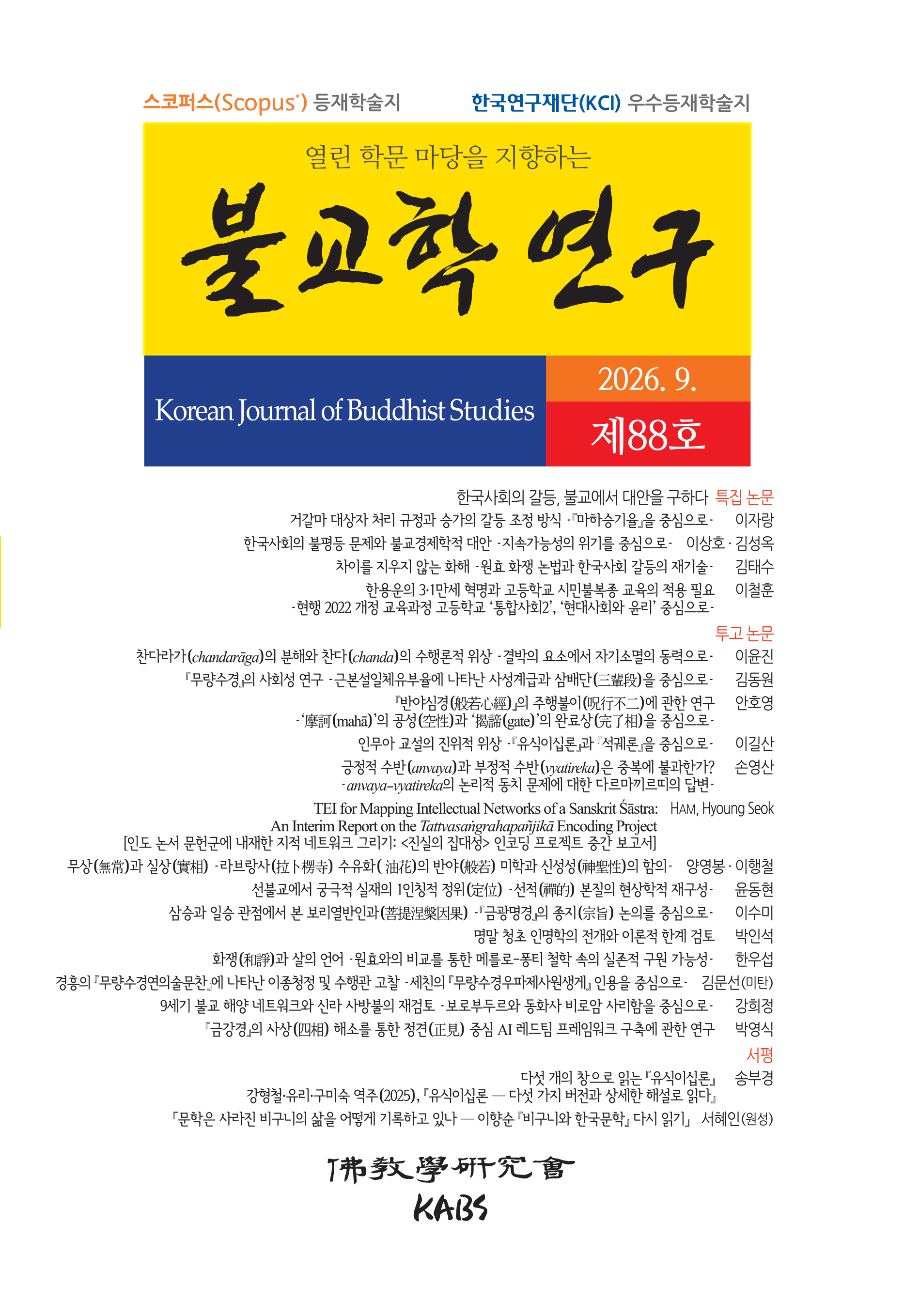
- Journal Title :Korean Journal of Buddhist Studies
- Journal Title(Ko) :불교학연구
- Volume : 88
- Pages :1∼27
- DOI :https://doi.org/10.21482/jbs.88..202609.1
 Korean Journal of Buddhist Studies