특집논문


Abstract
References
Information
“Environmental inequality” has recently emerged as a socioeconomic issue. Inequality is now being reconsidered alongside environmental problems in the context of the sustainability crisis. Because the crisis arising from inequality and environmental problems is a consequence of capitalist growthmania, it calls for critical reflection on capitalism. Buddhist economics can offer important insights into overcoming this crisis. The Buddha sought a way to eliminate the suffering of those living in this world. The principle of interdependence expresses a fundamental insight that does not draw an exclusive distinction between self and others, or between humans and nature. The Buddhist middle way can also help navigate the sustainability crisis by curbing the relentless pursuit of unending desires.
Developing realistic alternatives in response to the sustainability crisis requires to understand the characteristics of capitalist society. Capitalism subjects nature to unilateral human domination and continually imposes an ideology of competitive growthmania on economic actors. Under these competitive conditions, individuals struggle to sustain practices that embody the Buddhist doctrines of dependent origination and the middle way. Establishing a viable economic structure for Buddhist economics therefore requires efforts from both the Buddhist community and local communities. These efforts must take various coordinated, collective forms that include laypeople and monastics, and must in turn connect with local communities and civil society organizations.
Developing realistic alternatives in response to the sustainability crisis requires to understand the characteristics of capitalist society. Capitalism subjects nature to unilateral human domination and continually imposes an ideology of competitive growthmania on economic actors. Under these competitive conditions, individuals struggle to sustain practices that embody the Buddhist doctrines of dependent origination and the middle way. Establishing a viable economic structure for Buddhist economics therefore requires efforts from both the Buddhist community and local communities. These efforts must take various coordinated, collective forms that include laypeople and monastics, and must in turn connect with local communities and civil society organizations.
최근에 ‘환경 불평등’이 사회경제적 쟁점으로 부상하고 있다. 오늘날 불평등 문제가 환경문제와 함께 지속가능성의 위기 측면에서 새롭게 이해되는 것이다. 불평등 문제와 환경문제에서 비롯된 지속가능성의 위기는 자본주의적 성장지상주의의 산물이라는 점에서, 자본주의에 대한 반성적 성찰을 요구한다. 불교 정신에 바탕을 둔 불교경제학의 가르침은 이러한 위기를 극복하는 데 매우 중요한 함의를 지닐 수 있다. 붓다는 이 세상을 살아가는 이들이 겪게 되는 고통을 없애기 위한 길을 제시하고자 하였다. 그 가운데 우리가 경험하는 모든 것들은 다른 것들에 의지하여 일어난다고 하는 상호의존성의 원리, 즉 연기성에 관한 통찰은 자신과 타인, 인간과 자연을 배타적으로 구분하지 않는 근원적인 통찰을 보여준다. 또한 불교의 중도 사상은 끝없는 욕망 추구의 질주를 제어함으로써 지속가능성의 위기를 헤쳐 나갈 동력으로 작용할 수 있다.
지속가능성의 위기 상황에서 현실성 있는 대안을 제시하기 위해서는 자본주의 사회의 특징을 이해하는 것에서 출발할 필요가 있다. 자본주의는 자연을 인간의 일방적인 지배관계로 재편시키며, 경제 주체들에게 경쟁적인 성장지상주의를 끝없이 강요한다. 이러한 경쟁 메커니즘이 지배하는 상황에서는, 개인들이 불교의 연기설이나 중도 사상을 수용한 실천적 행위를 지속적으로 보여주기 어렵다. 그러므로 중도와 연기설에 바탕을 둔 불교경제학이 현실적인 경제구조를 확보하기 위해서는 불교계와 지역공동체의 노력이 모두 필요하다. 그 과정에서 재가자와 출가자를 포괄하는 다양한 형태의 유기적인 공동의 노력이 이루어져야 할 것이며, 그것은 다시 지역공동체나 시민사회 조직과 연계될 필요가 있다.
지속가능성의 위기 상황에서 현실성 있는 대안을 제시하기 위해서는 자본주의 사회의 특징을 이해하는 것에서 출발할 필요가 있다. 자본주의는 자연을 인간의 일방적인 지배관계로 재편시키며, 경제 주체들에게 경쟁적인 성장지상주의를 끝없이 강요한다. 이러한 경쟁 메커니즘이 지배하는 상황에서는, 개인들이 불교의 연기설이나 중도 사상을 수용한 실천적 행위를 지속적으로 보여주기 어렵다. 그러므로 중도와 연기설에 바탕을 둔 불교경제학이 현실적인 경제구조를 확보하기 위해서는 불교계와 지역공동체의 노력이 모두 필요하다. 그 과정에서 재가자와 출가자를 포괄하는 다양한 형태의 유기적인 공동의 노력이 이루어져야 할 것이며, 그것은 다시 지역공동체나 시민사회 조직과 연계될 필요가 있다.
- AN Aṅguttara Nikāya. DAERIM 대림, tr. 2006. 『앙굿따라니까야』 (Aṅguttara Nikāya), Ulsan: Center for Early Buddhist Studies 초기불전연구원.
- DN Dīgha Nikāya. KAKMUK 각묵, tr. 2006. 『디가니까야』 (Dīgha Nikāya), Ulsan: Center for Early Buddhist Studies 초기불전연구원.
- Dhp Dhammapada. ILA 일아, tr. 2015. 『담마빠다』 (Dhammapada), Seoul: Bulkwang Publishing 불광출판사.
- Sn Suttanipāta. ILA 일아, tr. 2015. 『숫따니빠따』 (Suttanipāta), Seoul: Bulkwang Publishing 불광출판사.
- BROWN, Clair & L. ZSOLNAI. 2018. “Buddhist Economics: An Overview,”
Society and Economy , vol. 40, no. 4, 497-513. 10.1556/204.2018.40.4.2 - BROWN, Clair. 2017.
Buddhist Economics: An Enlightened Approach to the Dismal Science , New York: Bloomsbury Press. - _______. 2022. “Buddhist Economics: A Guide to Creating an Equitable, Sustainable, Caring Market Economy,” in
The Spirit of Conscious Capitalism: Contributions of World Religions and Spiritualities , ed. by M. DION and M. PAVA, Springer, 361-377. 10.1007/978-3-031-10204-2_19 - _______. 2023. “Buddhist Economics: The Foundation for an Equitable, Sustainable, Caring Economy,”
The Yin-Cheng Journal of Contemporary Buddhism , vol. 1, no. 1, 199-219. 10.15239/ycjcb.01.01.07 - CHANCEL, Lucas. 2022. “Global Carbon Inequality over 1990-2019,”
Nature Sustainability , vol. 5, 931-938. 10.1038/s41893-022-00955-z - CHANCEL, Lucas, LEE Sejin 이세진, tr. 2023. 『지속 불가능한 불평등- 사회정의와 환경을 위하여』 (
Insoutenables inégalités–Pour une justice sociale et environnementale ), Seoul: NIKE Books 니케북스. - CHOI, Dukkyu 최덕규. 2009. 「한국경제의 양극화 문제- 불교적 접근」 (“The Korean economic polarization problem and solution from Buddhism”), 『한국교수불자연합학회지』 (
Journal of Buddhist Professors in Korea ), vol. 15, no. 2, 43-65. - CHO, Kiryong 조기룡. 2013. 「한국사회의 양극화 해소를 위한 불교교단의 역할- 대한불교조계종의 불교사회복지를 중심으로」 (“The Role of Buddhist Community in Resolving Korean Society's Bi-polarization– Focusing on Buddhist Social Welfare in Jogye Order of Korean Buddhism”), 『대각사상』 (
Maha Bodhi Thought ), vol. 19, 177-206. - _______. 2015. 「원효 화쟁의 사회적 실현을 위한 전제조건 고찰- 노사갈등에 대한 화쟁적 이해를 중심으로」 (“An Examination on the Preconditions for Social Realization of Wonhyo’s Harmonizing Disputes- Focusing on Understanding of Conflicts between Management and Labor in terms of Harmonizing Disputes”), 『불교학연구』 (
Korea Journal of Buddhist Studies ), vol. 43, 183-215. 10.21482/jbs..43.201506.183 - CHO, Seonghee 조성희 & JUNG, Yungsoon 정영순. 2019. 「근대이후 불교계 사회복지활동에 대한 고찰- 사회복지법인을 중심으로」 (“A Study on the Social Welfare Activities in Buddhism since the Modern Age- Focused on the Social Welfare Corporation”), 『동아시아불교문화』 (
Journal of eastern-asia buddhism and culture ), vol. 40, 597-623. 10.21718/EABC.2019.40.20 - CHO, Soodong 조수동. 2009. 「고령화 사회와 불교복지」 (“An aging society and the Buddhist Welfare”), 『철학논총』 (
Chulhak-ronchong ), vol. 55, no. 1, 63-85. - HWANG, Gyuseong 황규성. 2016. 「다중격차: 다차원적 불평등에 관한 개념화 시론」 (“In Search of Conceptualization of Multiple Disparities”), 『동향과 전망』 (
Journal of Korean Social Trend and Perspective ), no. 97, 9-44. - KWON, Kyeongim 권경임. 2009. 『현대불교사회복지론』 (*
Modern Buddhist Social Welfare Theory ), Seoul: Dongguk University Press 동국대학교출판부. - KWON, Ohmin 권오민, tr. 2002. 『아비달마구사론』 (
Abhidharmakośabhāṣya ), Seoul: Dongguk Institute of Scripture Translation 동국역경원. - LEW, Seungmu 류승무. 2009. 「참여불교의 관점에서 바라본 갈등시대 한국불교의 사회참여」 (“Korean Buddhism’s Social Participation in the Age of Conflicts from Engaged Buddhism’s Perspective”), 『불교학연구』 (
Korea Journal of Buddhist Studies ), vol. 24, 147-176. 10.21482/jbs.24..200912.147 - MIN, Kyungguk 민경국. 2010a. 「불교 사회철학의 문명비판에 대한 자유주의적 성찰」 (*“A Liberal Reflection on the Civilizational Critique of Buddhist Social Philosophy”), 『불교평론』 (
Buddhism Review ), no. 42, 110-131. - _______. 2010b. 「자유주의에 대한 비판과 그 치명적 결과」 (*“Critiques of Liberalism and Their Fatal Consequences”), 『불교평론』 (
Buddhism Review ), no. 44, 328-347. - NAKAMURA, Hajime 中村元, WONYOUNG 원영, tr. 2016. 『최초의 불교는 어떠했을까』 (*
What Was Earliest Buddhism Like? ), Seoul: Munye Publishing 문예출판사. - National Assembly of the Republic of Korea 대한민국국회. 2025. 「한국사회 불평등의 현주소: 2025 대한민국 불평등 종합보고서」 (*“The Current State of Inequalities in Korean Society: 2025 Comprehensive Report on Inequalities in the Republic of Korea”).
- PARK, Kwangjun 박광준. 2010. 『붓다의 삶과 사회복지』 (*
The Buddha's Life and Social Welfare ), Paju: Hangilsa 한길사. - PARK, Kyoungjoon 박경준. 2009. 「대승불교사상과 사회참여 一考」 (“A Study on Mahāyāna Buddhist Thought and Social Engagement”), 『불교학연구』 (
Korea Journal of Buddhist Studies ), vol. 24, 107-146. 10.21482/jbs.24..200912.107 - _______. 2006. 「지속가능한 발전과 불교경제학」 (*“Sustainable Development and Buddhist Economics”), in 『지식기반사회와 불교생태학』 (*
Knowledge-Based Society and Buddhist Ecology ), ed. by Helena NORBERG-HODGE, Seoul: Acanet 아카넷, 147-175. - PAK, Byungkee 박병기. 2010a. 「자유주의경제학의 치명적 낙관」 (*“The Fatal Optimism of Liberal Economics”), 『불교평론』 (
Buddhism Review ), no. 43, 290-315. - _______. 2010b. 「자유주의 경제학의 정체성은 무엇인가?」 (*“What Is the Identity of Liberal Economics?”), 『불교평론』 (
Buddhism Review ), no. 45, 131-149. - PAYUTTO, P. A. 1994.
Buddhist Economics: A Middle Way for the Market Place , 2nd ed., Bangkok: Buddhadhamma Foundation. - PIKETTY, Thomas. 2014.
Capital in the Twenty-First Century , tr. by A. GOLDHAMMER, Cambridge: Harvard University Press. - RICARD, Matthieu 마티유 리카르, LEE Hŭisu 이희수, tr. 2015. 『이타심: 자신과 세상을 바꾸는 위대한 힘』 (
Plaidoyer pour l'altruisme: la force de la bienveillance ), Seoul: Haruhun 하루헌. - SCHUMACHER, E. F., LEE Sangho 이상호, tr. 2022. 『작은 것이 아름답다』 (
Small Is Beautiful ) 2판, Seoul: Munye Publishing 문예출판사. - SCHUMACHER, E. F., LEE Seungmu 이승무, tr. 2013. 『내가 믿는 세상』 (
This I Believe and Other Essays ), Seoul: Munye Publishing 문예출판사. - SEN, A. K. 1992.
Inequality Reexamined , Cambridge: Harvard University Press. - _______. 1999.
Development as Freedom , New York: Alfred A. Knopf. - SIVARAKSA, Sulak 술락 시바락사, Lee Jeongmin 이정민, tr. 2018. 『불교경제학』 (
The Wisdom of Sustainability: Buddhist Economics for the 21st Century ), Seoul: Jungto Publishing 정토출판. - SEO, Byungjin 서병진. 2013. 「한국불교와 사회복지」 (“Korean Buddhism and Social Welfare”), 『정토학연구』 (
Journal of Pure Land Buddhist Studies ), vol. 19, 175-234. - SHON, Seokchoon 손석춘. 2019. 「지속가능한 발전과 불교적 이상사회」 (“Sustainable Development and the Buddhist Ideal Society”), 『한국불교학』 (
The Journal of the Korean Association for Buddhist Studies ), vol. 91, 39-68. 10.22255/JKABS.91.2 - LEE, Hesook 이혜숙. 2013. 「불교사회복지학의 성과와 전망」 (“Overall review of the buddhist social welfare studies”), 『한국불교학』 (
The Journal of the Korean Association for Buddhist Studies ), vol. 68, 789-821. 10.22255/JKABS.107.10 - LEE, Myoungho 이명호. 2023. 「복합위기 시기, 불교의 사유에 근거한 생태적 돌봄 전망하기」 (“Ecological Care in Times of Complex Crisis: Insights from a Buddhist Thinking”), 『한국불교학』 (
The Journal of the Korean Association for Buddhist Studies ), vol. 107, 293-328.
◆ 약호 및 일차 문헌 Abbreviations and Primary Sources
◆ 이차 문헌 Secondary Literature
- Publisher :Korean Association of Buddhist Studies
- Publisher(Ko) :불교학연구회
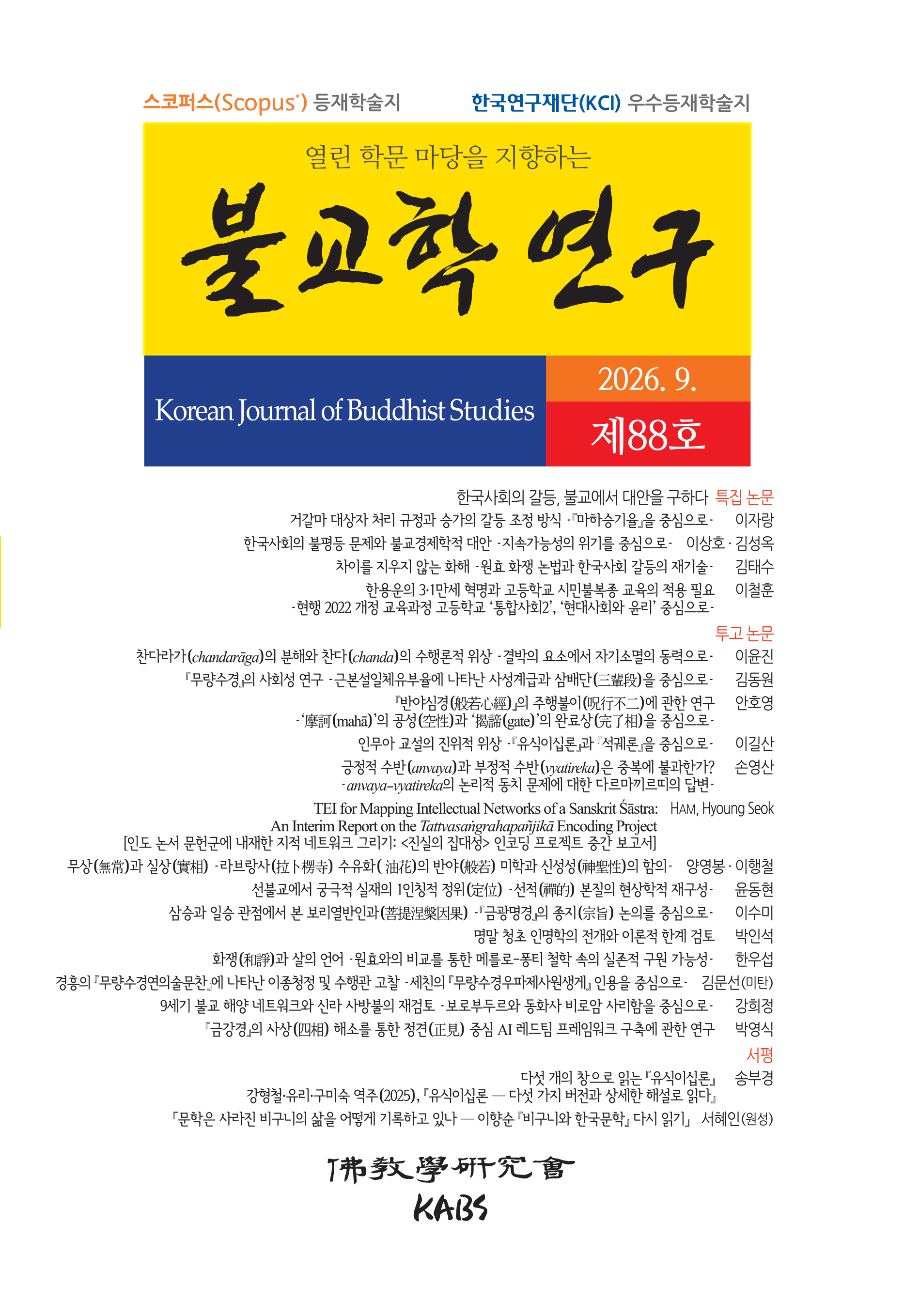
- Journal Title :Korean Journal of Buddhist Studies
- Journal Title(Ko) :불교학연구
- Volume : 88
- Pages :29∼55
- DOI :https://doi.org/10.21482/jbs.88..202609.29
 Korean Journal of Buddhist Studies