투고논문


Abstract
References
Information
This study begins from the two faces that desire (chanda ) wears in the early canon. On one side it is an obstacle to be abandoned — the sensual desire (kāmacchanda ) heading the five hindrances and the desire-and-lust (chandarāga ) that fetters at the six sense-spheres; on the other it is a quality to be cultivated, the first of the four bases of spiritual power (iddhipāda ). Because desire (chanda ) and craving (taṇhā ) have long been read as interchangeable, this paper clarifies the source of that conflation and argues that the decomposition of chandarāga — the falling away of lust (rāga ) and the remaining of desire — is itself the driving force of practice. The taṇhā -expansion sequence of the Mahānidāna-sutta places chandarāga on one causal chain between craving and clinging (upādāna ), the root of their conflation; yet the Nettippakaraṇa distinguishes two cravings by object, and the Abhidhamma marks chanda as ethically variable by root, so that craving is fixed as unwholesome while desire can be either wholesome or unwholesome. Lust-tinged desire is kindled at contact (phassa ) and becomes the very fetter binding faculty and object — neither of which, as the Koṭṭhika-sutta shows, is the fetter — so that what practice governs is not the object but this chandarāga : its outward aspect. Lust-freed desire, by contrast, stands as the first base of spiritual power, grounds concentration and striving, and dissolves craving: its inward aspect. The Uṇṇābhabrāhmaṇa-sutta teaches that one abandons desire in dependence on desire, and that this desire, once arahantship is attained, subsides of itself — a stilling that is self-completion, not self-destruction. The task of practice is thus not to abolish desire but to strip its lust, so that desire, having accomplished its aim, comes to rest of itself: the recursive self-dissolution of desire.
본 연구는 초기경전에서 찬다(欲, chanda )가 버려야 할 감각적 욕망(kāmacchanda )과 찬다라가(欲貪, chandarāga )로 나타나는 한편, 다른 한편으로는 닦아야 할 사여의족(四如意足)의 첫 기반으로 나타나는 두 측면에서 출발한다. 본 연구의 목적은 찬다와 갈애가 오래 혼용되어 온 연원을 밝히고, 찬다라가라는 복합어에서 탐(貪, rāga )이 탈락하고 찬다가 남는 과정이 곧 수행의 동력임을 규명하는 데 있다. 「마하니다나 숫따(Mahānidānasutta )」의 갈애 확장 연기는 갈애가 추구·획득·결정을 거쳐 찬다라가로, 다시 탐착으로 이어지는 과정을 드러내어, 찬다라가를 갈애와 취(取) 사이에서 판별을 거쳐 짙어진 심화의 마디로 자리매김한다. 이 연쇄가 두 낱말이 혼용되어 온 뿌리를 이루며, 그 혼용은 『네띠빠까라나』의 두 갈애가 대상에 의해, 아비담마의 가변적 찬다가 뿌리에 의해 갈린다는 변별로 정리된다. 갈애는 불선으로 고정된 심소이고, 찬다는 함께하는 마음에 따라 선·불선에 두루 통하는 가변의 심소이다. 탐에 물든 찬다는 촉(觸)에서 일어나 근(根)과 경(境)을 묶는 결박이 되는데, 「꼿티까 숫따」가 밝히듯 그 결박은 감각기관도 대상도 아니라 그 둘을 의존하여 일어나는 찬다라가이다. 따라서 다스릴 표적은 대상이 아니라 이 찬다라가이며, 이것이 찬다라가의 외향(外向)이다. 반대로 탐을 벗은 찬다는 사여의족의 첫 기반에 서서 삼매와 정근을 일으키고 갈애를 소멸시키는 내향(內向)의 힘이 된다. 「운나바 숫따」는 찬다에 의지하여 찬다를 버리며, 그 버림이 목적을 이루면 아라한과에서 찬다가 스스로 가라앉음을 보여 준다. 이 가라앉음은 억압에 의한 소멸이 아니라 목적을 이룬 결과이므로, 자기 파괴가 아니라 자기 완성이다. 곧 외향에서 내향으로의 전환은 탐의 빛바램(rāgavirāga )이며, 수행의 과제는 찬다를 없애는 것이 아니라 그 탐을 제거하여 찬다가 스스로 소멸하도록 하는 데 있다.
- AN. Aṅguttara-Nikāya, ed. by R. MORRIS and E. HARDY, 5 vols., London: The Pali Text Society, 1885-1900 (reprints).
- Dhs. Dhammasaṅgaṇī, ed. by Edward Müller, London: The Pali Text Society, 1885 (rpt. 1978).
- DN. Dīgha-Nikāya, ed. by T. W. RHYS DAVIDS and J. E. CARPENTER, 3 vols., London: The Pali Text Society, 1890-1911 (reprints).
- MN. Majjhima-Nikāya, ed. by V. TRENCKNER and R. CHALMERS, 3 vols., London: The Pali Text Society, 1888-1902 (reprints).
- Nett. Nettippakaraṇa, ed. by E. HARDY, London: The Pali Text Society, 1902.
- SN. Saṃyutta-Nikāya, ed. by L. FEER, 5 vols., London: The Pali Text Society, 1884-1898 (reprints).
- Spk. Sāratthappakāsinī (Saṃyutta-Nikāya-aṭṭhakathā), ed. by F. L. WOODWARD, 3 vols., London: The Pali Text Society, 1929-1937.
- Sv. Sumaṅgalavilāsinī (Dīghanikāya-aṭṭhakathā), ed. by T. W. RHYS DAVIDS, J. E. CARPENTER, and W. STEDE, 3 vols., London: The Pali Text Society, 1886-1932.
- Vism. Visuddhimagga, ed. by C. A. F. RHYS DAVIDS, 2 vols., London: The Pali Text Society, 1920-1921 (reprint).
- BODHI, Bhikkhu. 1984.
The Great Discourse on Causation: The Mahānidāna Sutta and Its Commentaries , Kandy: Buddhist Publication Society. - BUSWELL, Robert E. Jr. and Donald S. LOPEZ Jr. 2014.
The Princeton Dictionary of Buddhism , Princeton: Princeton University Press. 10.1515/9781400848058 - CHO, Joon-Ho 조준호. 2009.「무명(無明)과 공(空) ― 욕망의 비실재성에 대한 불교적 통찰」 (“Ignorance and Emptiness: Buddhist Insight into the Unreality of Desire”), 『불교학연구』 (
Korea Journal of Buddhist Studies ), vol. 24, 177-219. 10.21482/jbs.24..200912.177 - CONE, Margaret. 2001. A Dictionary of Pāli, Part I (a–kh), Oxford: The Pali Text Society.
- DAELIM 대림, tr. 2022. 『청정도론 2』 (
Visuddhimagga 2 ), Ulsan: Center for Early Buddhist Studies 초기불전연구원. - DAELIM and GAKMUK 대림·각묵, tr. 2019. 『아비담마 길라잡이 1』 (
A Comprehensive Manual of Abhidhamma 1 ), Ulsan: Center for Early Buddhist Studies 초기불전연구원. - HA, Dae-Yong 하대용. 2026. 「초기불교 경전에서 산냐(saññā)의 인식론적 전이 구조 ― sañjānāti에서 pajānāti로의 서술적 이행을 중심으로」 (“The Epistemological Transition Structure of saññā in the Early Buddhist Scriptures”), 『한국불교학』 (
Journal of the Korean Association for Buddhist Studies ), vol. 118, 9-42. 10.22255/JKABS.118.01 - HARVEY, Peter. 2013.
An Introduction to Buddhism: Teachings, History and Practices , 2nd ed., Cambridge: Cambridge University Press. 10.1017/CBO9781139050531 - JEON, Jae-seong 전재성, tr. 2014a. 『맛지마니까야』 (
Majjhima-Nikāya ), Seoul: Korea Pali Text Society 한국빠알리성전협회. - _______. 2014b. 『쌍윳따니까야』 (
Saṃyutta-Nikāya ), Seoul: Korea Pali Text Society 한국빠알리성전협회. - _______. 2016. 『디가니까야』 (
Dīgha-Nikāya ), Seoul: Korea Pali Text Society 한국빠알리성전협회. - JEONG, Jun-Young 정준영. 2008. 「초기불교의 욕망 이해: 욕망의 다양한 의미」 (“The Understanding of Desire in Early Buddhism: The Manifold Meanings of Desire”), 『욕망, 삶의 동력인가 괴로움의 뿌리인가』 (
Desire: Driving Force of Life or Root of Suffering ), Seoul: Unjusa 운주사, 27-58. - KIM, Han-Sang 김한상. 2019. 「초기 인도불교의 고행 ― 느낌과 갈애 간의 조건적 관계를 중심으로」 (“Asceticism in Early Indian Buddhism: Focusing on the Conditional Relationship between Feeling and Craving”), 『불교학보』 (
Journal of Buddhist Studies ), vol. 87, 9-29. 10.18587/bh.2019.6.87.9 - LEE, You Mee. 2009.
Beyond Āsava and Kilesa: Understanding the Roots of Suffering according to the Pāli Canon , Dehiwala: Buddhist Cultural Centre. - LIM, Seung-Taek 임승택, SEO, Gap-Seon 서갑선, and LEE, Chun-Ok 이춘옥, tr. 2014. 『네띠빠까라나』 (
Nettippakaraṇa ), Seoul: Hakgobang 학고방. - NYANATILOKA. 2007.
Buddhist Dictionary: Manual of Buddhist Terms and Doctrines , Chiang Mai: Silkworm Books. - PARK, Jae-Eun 박재은. 2021. 「갈애의 발생과 소멸에 관한 일고찰 ― 빠알리 문헌을 중심으로」 (“A Study on the Arising and Cessation of Craving (taṇhā): Focusing on the Pāli Literature”), 『한국불교학』 (
Journal of the Korean Association for Buddhist Studies ), vol. 99, 139-167. 10.22255/JKABS.99.6. - PAYUTTO, P. A. 2024.
The Essential Buddhadhamma: The Teachings and Practice of Theravāda Buddhism , Boston: Shambhala. - WEBSTER, David. 2011.
The Philosophy of Desire in the Pāli Canon , London and New York: Routledge. - WOO, Dong-Pil 우동필. 2014. 「『MN 9경』과 『중아함 29경』에 나타난 무명과 누의 해석 문제」 (“The Problem of Interpreting Ignorance (avijjā) and the Taints (āsava) in the Sammādiṭṭhi-sutta (MN 9) and the Madhyamāgama Discourse 29”), 『선문화연구』 (
Journal of Seon Culture ), vol. 16, 173-216. - _______. 2015. 「역관(逆觀)의 십이연기 ― 십이연기와 중도의 관계」 (“The Twelvefold Dependent Origination in Reverse Contemplation: The Relation between Dependent Origination and the Middle Way”), 『불교학연구』 (
Korea Journal of Buddhist Studies ), vol. 44, 1-33. - _______. 2018. 「중과 전회 ― 연기에 대한 철학적 탐구」 (“The Middle and the Turn: A Philosophical Inquiry into Dependent Origination”), 『불교학연구』 (
Korea Journal of Buddhist Studies ), vol. 57, 149-188. 10.21482/jbs.57..201812.149 - _______. 2019. 「염(念, sati)과 견(見, diṭṭhi) ― 지·관(止觀, samatha-vipassanā) 구분의 기준에 대하여」 (“Sati and Diṭṭhi: On the Criterion for Distinguishing samatha and vipassanā”), 『불교학연구』 (
Korea Journal of Buddhist Studies ), vol. 61, 105-132. 10.21482/jbs.61..201912.105
◆ 약호 및 일차 문헌 Abbreviations and Primary Sources
◆ 이차 문헌 Secondary Literature
- Publisher :Korean Association of Buddhist Studies
- Publisher(Ko) :불교학연구회
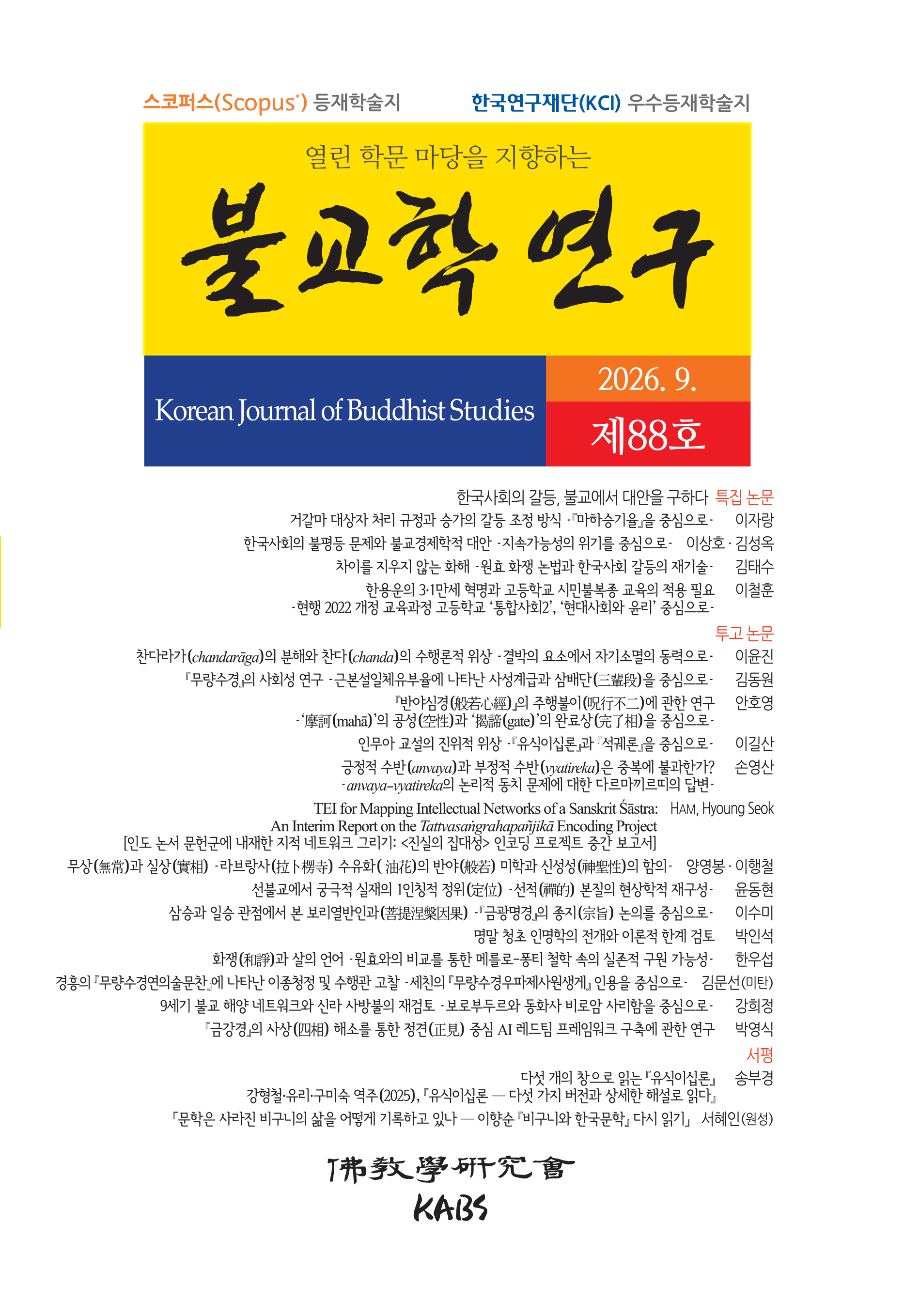
- Journal Title :Korean Journal of Buddhist Studies
- Journal Title(Ko) :불교학연구
- Volume : 88
- Pages :117∼148
- DOI :https://doi.org/10.21482/jbs.88..202609.117
 Korean Journal of Buddhist Studies