투고논문


Abstract
References
Information
This paper examines Dharmakīrti’s response to the redundancy problem arising from the logical equivalence of the second characteristic, anvaya (positive concomitance), and the third characteristic, vyatireka (negative concomitance), in Dignāga’s theory of the three characteristics of a valid logical reason (trairūpya ). Dignāga uses the restrictive particle eva to define these two characteristics in his Pramāṇasamuccayavṛtti (PSV). The propositions expressing anvaya and vyatireka consequently form a pair of contrapositives and are logically equivalent, raising the question of why they should be stated as separate characteristics of a valid reason. The paper first traces the emergence of this problem in Dignāga’s Pramāṇasamuccaya (PS) and PSV, then analyzes Dharmakīrti’s responses in the Pramāṇaviniścaya (PVin) and Hetubindu (HB). Dharmakīrti accepts that a statement of either anvaya or vyatireka can indicate the other, but maintains that this mutual indication does not imply their essential identity. Distinguishing statements used in an argument (prayoga ) from the characteristics (rūpa ) themselves, he maintains that presence in similar instances and absence from dissimilar instances are distinct characteristics. According to Dharmakīrti, one statement can indicate the other because of the force (sāmarthya ) of a proposition containing a restriction (niyama ), rather than because of mutual implication or inclusion. Finally, the study compares the Sanskrit HB, Hetubinduṭīkā , and Hetubinduṭīkāloka with the relevant Tibetan translations and the modern critical editions. It argues that the Sanskrit materials, which consistently deny mutual dependence, implication, and inclusion between the two characteristics, accord more closely with Dharmakīrti’s original intention. His response can therefore be understood as an attempt to preserve Dignāga’s trairūpya theory while resolving its inherent redundancy problem.
본 연구는 디그나가(Dignāga)의 ‘추론근거의 세 가지 특징’(trairūpya ) 이론에서 제2 특징인 긍정적 수반(anvaya )과 제3 특징인 부정적 수반(vyatireka )이 논리적 동치 관계에 놓이면서 발생하는 중복 문제와 이에 대한 다르마끼르띠(Dharmakīrti)의 답변을 검토하는 것을 목적으로 한다. 디그나가는 Pramāṇasamuccaya (PS)에 대한 자신의 주석 Pramāṇasamuccayavṛtti (PSV)에서 eva 한정사를 사용함으로써 추론근거의 존재 영역을 추론대상의 존재 영역으로 한정하고, 추론대상이 부재하는 영역에서 추론근거의 존재 가능성을 배제하였다. 그러나 이에 따라 긍정적 수반과 부정적 수반은 논리적 대우 관계에 놓이게 되며, 왜 양자를 별개의 두 특징으로 제시해야 하는지가 문제로 제기된다. 본 연구는 이 문제에 대한 다르마끼르띠의 Pramāṇaviniścaya (PVin)와 Hetubindu (HB)에서의 답변을 분석하였다. 다르마끼르띠는 긍정적 수반과 부정적 수반의 상호 지시 가능성을 인정하면서도, 논증에 적용되는 진술(prayoga )의 차원과 추론근거의 특징(rūpa )의 차원을 구분함으로써 양자가 본질적으로는 별개의 특징임을 주장한다. 즉 어느 한쪽의 진술만으로 다른 한쪽이 이해되는 것은 양자가 서로를 함축하거나 포함하기 때문이 아니라, 한정(niyama )을 가진 명제가 갖는 효력(sāmarthya )에 기인한다는 것이다. 나아가 본 연구는 HB, HBṬ, HBṬĀ의 산스크리트 자료와 관련 티벳어 번역 및 현대 교정본을 비교하여, 긍정적 수반과 부정적 수반의 상호 비의존성과 비함축성을 주장하는 산스크리트 자료들의 독해가 다르마끼르띠의 의도에 보다 부합함을 논증한다. 이를 통해 다르마끼르띠의 답변이 긍정적 수반과 부정적 수반의 논리적 동치를 부정하는 것이 아니라, 그 상호 지시 가능성과 두 특징의 본질적 독립성을 서로 다른 차원에서 설명함으로써 디그나가의 trairūpya 이론을 유지하려는 시도였음을 밝힌다.
- DhPr
Dharmottarapradīpa (Durvekamiśra):Paṇḍita Durveka Miśra’s Dharmottarapradīpa - being a sub-commentary on Dharmottara’s Nyāyabinduṭīkā, a commentary on Dharmakīrti’s Nyāyabindu . Ed. Dalsukhbhai Malvania. Tibetan Sanskrit Works Series 2 (TSWS 2), Patna: Kashi Prasad Jayaswal Research Institute, 1955. - HB
Hetubindu (Dharmakīrti):Dharmakīrti’s Hetubindu . Ed. Ernst Steinkellner, Helmut Krasser, Klaus Wille, Beijing-Vienna: China Tibetology Publishing House (CTPH) – Austrian Academy of Sciences Press (AASP), 2016. - HBt Tibetan translation of the
Hetubindu of Dharmakīrti (gtan tshigs kyi thigs pa zhes bya ba’i rab tu byed pa , i.e.,Hetubinduprakaraṇa ), Derge No. 4213, Tshad ma, Ce, D238a7-D255a1. - HBṬĀ Hetubinduṭīkāloka (Durvekamiśra): In HBṬ(Ed.).
- HBṬt Tibetan translation of the
Hetubinduṭīkā of Arcaṭa (gtan tshigs thigs pa’i ʼgrel pa, i.e., Hetubinduvivaraṇa ) [hetulakṣaṇa controversy part] Derge No.4235, Tshad ma, We, D311b6-D327a7; Peking No.5734, Tshad ma, She, P383b7-P402a8. - HBṬ(Ed.)
Hetubinduṭīkā (Arcaṭa):Hetubinduṭīkā of Bhaṭṭa Arcaṭa with the sub-commentary entitled Āloka of Durveka Miśra . Edited by Pandit Sukhlalji Sanghavi and Muni Shri Jinavijayaji (GOS 113), Baroda: Oriental Institute, 1949. - NB
Nyāyabindu (Dharmakīrti): In DhPr. - NS
Nyāyasūtra (Gautama): In NV. - NV
Nyāyavārttika (Uddyotakara):Nyāyabhāṣyavārttika of Bhāradvāja Uddyotakara , Edited by Anantalal Thakur, New Delhi: Indian Council of Philosophical Research, 1997. - PSṬ II. Pramāṇasamuccayaṭīkā (Jinendrabuddhi): Jinendrabuddhi’s Viśālāmalavatī
Pramāṇasamuccayaṭīkā Chapter 2. Part I, Ed. Horst Lasic, Helmut Krasser, Ernst Steinkellner, Sanskrit Texts from the Tibetan Autonomous Region (STTAR)15/1, Beijing-Vienna: China Tibetology Publishing House (CTPH) – Austrian Academy of Sciences Press (AASP), 2012. - PV(G)
Pramāṇavārttika (Dharmakīrti):The Pramāṇavārttikam of Dharmakīrti - The First Chapter with the Autocommentary Text and Critical Notes . Ed. Gnoli, Raniero. Roma: Istituto Italiano Per Il Medio Ed Estremo Oriente (Serie Orientale Roma XXIII), 1960. - PVSV
Pramāṇavārttikasvavṛtti (Dharmakīrti): In PV(G). - PV(S)
Pramāṇavārttika (Dharmakīrti):Pramāṇavārttikam by Ācārya Dharmakīrti . Ed. Rāhula Sāṅkṛtyāyana, Patna: Journal of the Bihar and Orissa Research Society, 1938. - PVVM(P)
Pramāṇavārttikavṛtti (Manorathanandin):The Pramāṇavārttikam of Ācārya Dharmakīrti: With the commentaries Svopajñavṛtti of the author and pramāṇavārttikavṛtti of Manorathanandin . Ed. Ram Chandra Pandeya, Delhi: Motilal Banarsidass, 1989. - PVVM(S)
Pramāṇavārttikavṛtti (Manorathanandin):Dharmakīrti’s Pramāṇavārttika with a commentary by Manorathanandin . Ed. Rāhula Sāṅkṛtyāyana, (Appendix to JBORS 24-26) Patna: Bihar and Orissa Research Society, 1938-1940. - PVin I & II.
Pramāṇaviniścaya (Dharmakīrti):Dharmakīrti’s Pramāṇaviniścaya Chapters 1 and 2, Edited by Ernst Steinkellner. Wien: Verlag der Österreichischen Akademie der Wissenschaften, 2007. - CHI, R. S. Y. 1984.
Buddhist Formal Logic , Delhi: Motilal Banarsidass. - DUNNE, John D. 2004.
Foundations of Dharmakīrti’s Philosophy , Boston: Wisdom Publications. - FRANCO, Eli. 2017. “Dharmakīrti,” in K. H. Potter, ed.,
Encyclopedia of Indian Philosophies, Vol. 21: Buddhist Philosophy from 600 to 750 A.D ., 51-136, Delhi: Motilal Banarsidass Publishers. - HAYES, Richard P. 1980. “Diṅnāga’s Views on Reasoning (Svārthānumāna),”
Journal of Indian Philosophy , vol. 8, no. 3, 219-277. 10.1007/BF00166296 - IWATA, Takashi. 2004. “The Negative Concomitance (
vyatireka ) in the Case of Inconclusive (anaikāntika ) Reasons,” inThe Role of the Example (dṛṣṭānta) in Classical Indian Logic , edited by Shōryū Katsura and Ernst Steinkellner, 91-134, Wien: Arbeitskreis für Tibetische und Buddhistische Studien, Universität Wien. - KATSURA, Shōryū. 1983. “Dignāga on
Trairūpya ,”Journal of Indian and Buddhist Studies (Indogaku Bukkyogaku Kenkyu) , vol. 32, no. 1, 544-538. 10.4259/ibk.32.544 - KATSURA, Shōryū. 2000. “Dignāga on
trairūpya Reconsidered: A Reply to Prof. Oetke,” in インドの文化と論理, 241–266, Fukuoka: Kyushu University Press (九州大学出版会). - KITAGAWA, Hidenori. 1965. インド古典論理学の研究 : 陳那(Dignāga)の体系, Tōkyō: 鈴木学術財団.
- MATILAL, B. K. 1990.
Logic, Language, and Reality - Indian Philosophy and Contemporary Issues , Delhi: Motilal Banarsidass Publishers. - STEINKELLNER, Ernst. 1979.
Dharmakīrti’s Pramāṇaviniścayaḥ - Zweites Kapitel: Svārthānumānam, Teil II Übersetzung und Anmerkungen , Wien: Verlag der Österreichischen Akademie der Wissenschaften. - STEINKELLNER, Ernst. 1988. “Remarks on Niścitagrahaṇa,” in
Orientalia Iosephi Tucci memoriae dicata , 1427-1444, Roma: Istituto Italiano per il Medio ed Estremo Oriente. - STEINKELLNER, Ernst. 2022a.
A Splash of the Logical Reason: Dharmakīrti’s Hetubindu Translated , Wien: Verlag der Österreichischen Akademie der Wissenschaften. - STEINKELLNER, Ernst. 2022b. “Further and last corrigenda and addenda of Ernst Steinkellner, 2016. Dharmakīrti’s
Hetubindu ” https://www.oeaw.ac.at/fileadmin/Institute/IKGA/PDF/digitales/Steinkellner_2022_HB_Further_and_Last_Corrigenda.pdf - TILLEMANS, Tom J. F. 1999.
Scripture, Logic, Language , Boston: Wisdom Publications. - SOHN, Youngsan 손영산. 2022. 「‘타당한 추론 근거의 특징’(
hetulakṣaṇa )에 관한 논쟁, 다르마끼르띠의 논적은 누구인가?-『헤뚜빈두』(Hetubindu )에 나타난 6상설의 니야야(Nyāya) 귀속가능성 검토」, 『불교학연구』, vol. 73, 1-29.
◆ 약호 및 일차 문헌 Abbreviations and Primary Sources
◆ 이차 문헌 Secondary Literature
- Publisher :Korean Association of Buddhist Studies
- Publisher(Ko) :불교학연구회
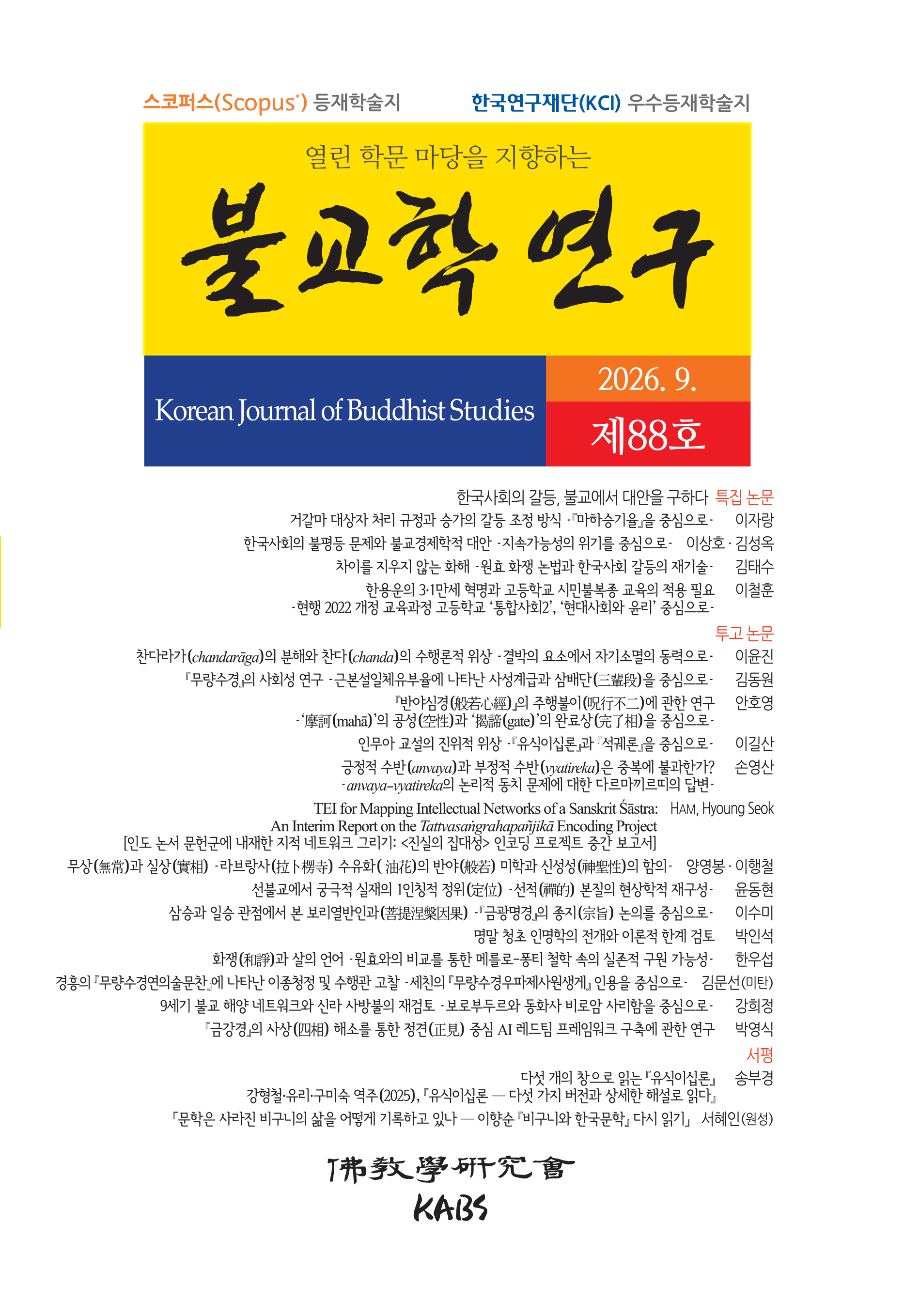
- Journal Title :Korean Journal of Buddhist Studies
- Journal Title(Ko) :불교학연구
- Volume : 88
- Pages :235∼264
- DOI :https://doi.org/10.21482/jbs.88..202609.235
 Korean Journal of Buddhist Studies